

Some very good subscriber-only content this week: What Are You Cooking/Assembling for Weeknight Dinner and Your First Memory of Beauty.
Also this is your LAST CHANCE to complete the Culture Study survey — if you want more content like this, if there’s something else you want more of, if you have ideas for future threads, tell me about it! Just click here.
When we taped the baseball culture episode of The Culture Study Podcast last week, we tried to answer a question from a listener about why baseball feels like such a dad sport. We came up with a bunch of theories, which you can listen to here, but my theory is that baseball viewing evokes a particular sort of dadness: a sit-in-the-old-recliner-by-yourself-with-the-AM-radio-on Dad, which is to say, a chill Dad, a contemplative Dad, a Dad who’s always trying to get you to sit there with him.
Baseball is not a sport of aggression or frenzy, and neither, at least stereotypically, are its fans. Baseball is also historically accessible: unlike football or basketball, a ticket in the nosebleeds during the regular season costs less than going out for pizza. Baseball is an endurance sport for fans: the season lasts forfuckingever but manages to combine the excitement of spring, the endless nights of summer, and the wistfulness of fall, and invites you to appreciate them all, the way a Dad would tell you to come watch the thunderstorm with him, or take a look at that cool tree looking its leaves, or ask anyone and everyone: can’t you feel Spring in the air?
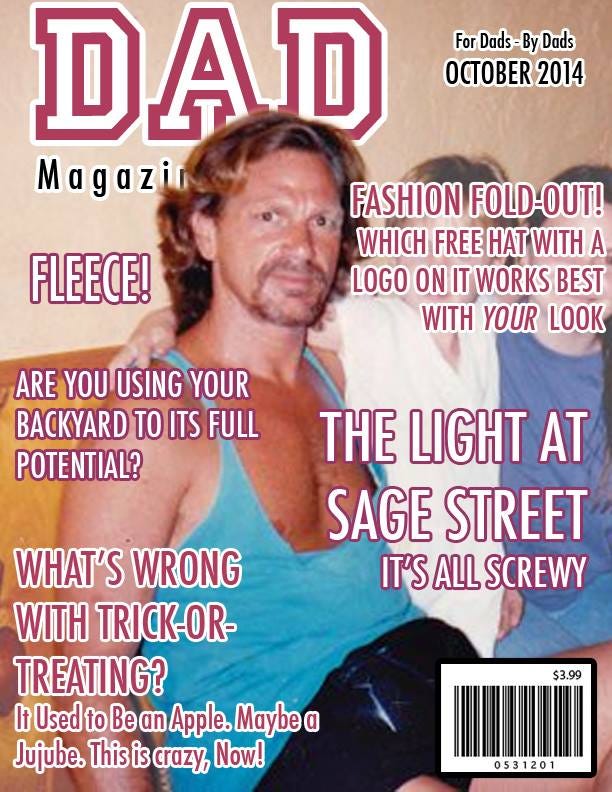
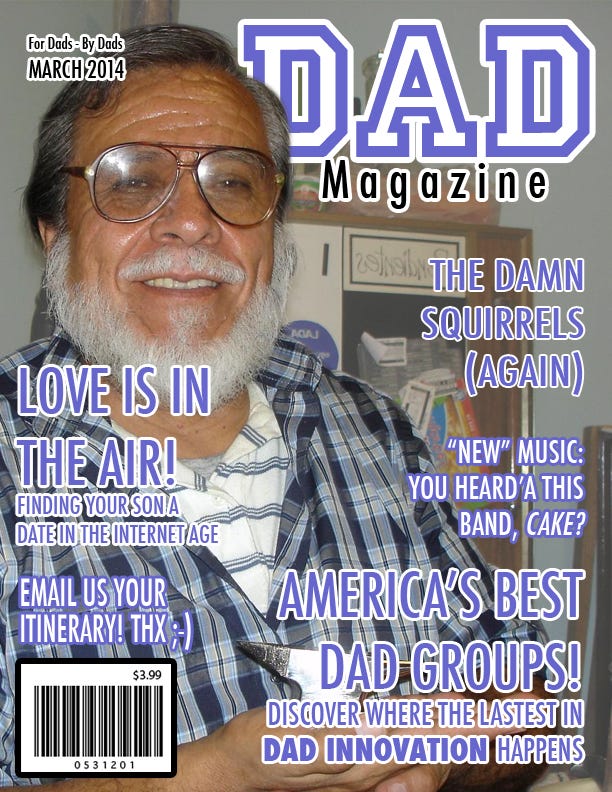
Baseball Dad is channeling the spirit at the heart of Dad Magazine, which Jaya Saxena and Mattie Lubchansky imagined so vividly for The Toast (RIP, even its archives) more than a decade ago:
See also:
The Baseball Dad, at least how we’re conceiving of him here, is a Good Dad: caring but not controlling, concerned but not terrified. He likes gadgets but isn’t obsessed. He loves a deal. He’s not rich. He’s present. He adores his kids and is kind to his wife or ex-wife or husband (gay dads are often but not always good dads). His masculinity is not rigid, is not anxious, and is not obsessed with self-replication. He is often stubborn but not intractable; Good Dads have been known to change their minds, especially about social issues.
Good Dads get annoyed by things but very rarely furious. They often grew up with some sort of moral code but are no longer staunchly religious. They lack self-consciousness. They’ll do the electric slide for the jumbrotron without even thinking about it. They love a backyard BBQ more than a tailgate, and they like a 4 o’clock beer on a Sunday but never drink to oblivion. They like to tinker more than complete. The Good Dad would pretty much always like to play a game of cards with you, or maybe just go on a drive. That sounds nice.

 Tiktok failed to load.
Enable 3rd party cookies or use another browser
Good Dads are usually depicted as white and suburban but that’s because a lot of media still insists on representing anyone good as white and suburban. Good dads are of every race, have every accent, and live all over; components of the Good Dadness (the beer in the bottle, just to start) feel specific to the US and Canada, but can readily be interchanged with culturally specific features from other countries. Women and non-binary people can be Good Dads, too, because Dadness is a behavior, not a gender.
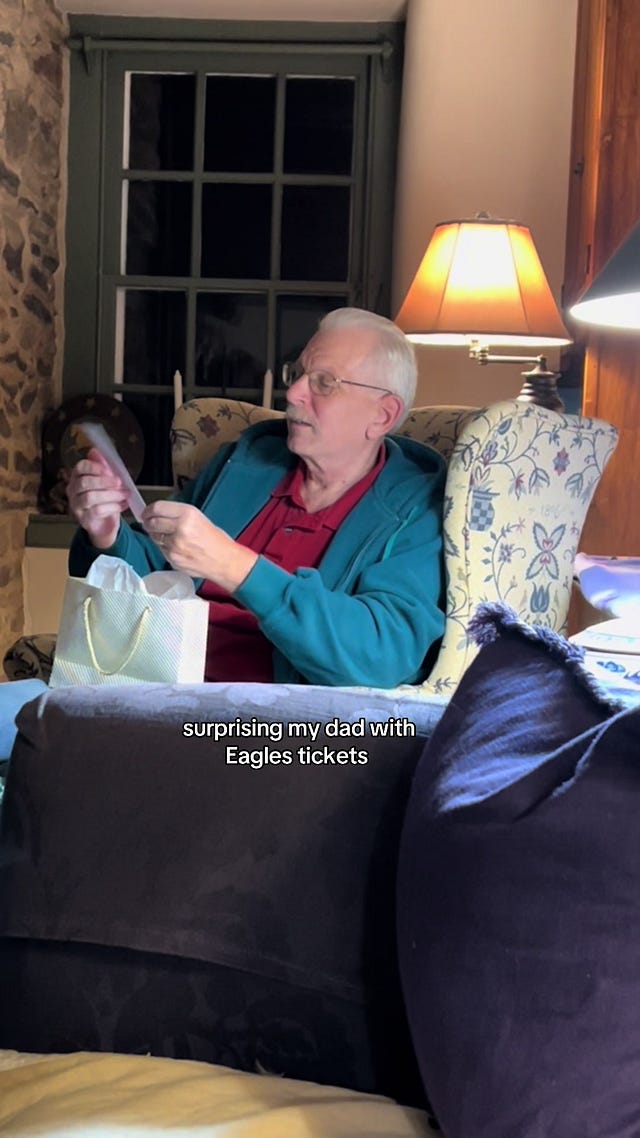
The Good Dad is also defined in part by what he is not: The Bad Dad. Here’s where I’m gonna piss some people off and say that the statistical likelihood of a Dad being a Bad Dad goes up when his primary sport is football (or golf) instead of baseball. Not all football fans are Bad Dads, but most Bad Dads are football fans. (For evidence of Good Football Dads, see below).
 Tiktok failed to load.
Enable 3rd party cookies or use another browser
The Bad Dad is not that guy. The Bad Dad has a temper which he acknowledges and for which he periodically apologizes. But the Bad Dad is resistant to shame. Most dads like the sound of their own voice but Bad Dads like the sound of their voice most when they are lecturing or yelling. Bad Dads are rude to waiters. They think not tipping is a way of encouraging someone to do better. When the Bad Dad gets drunk, he’s angry and spitting. If the Bad Dad doesn’t drink, he lords his sobriety over everyone. The Bad Dad is always right, even and especially when he is very, very wrong.
Unlike the Good Dad, who is represented across all races, the Bad (American) Dad is almost always white, because the primary force animating the Bad Dad is the performance and maintenance of dominance. The Bad Dad’s love is conditional: he loves his wife, but only when she performs and looks a certain way. He loves his children, but only when they behave in accordance with his exacting yet somehow still vague standards of behavior. He loves his friends, but his friends are, conveniently, also Bad Dads.
Bad Dads love gear but only new gear. Bad Dads have very little tolerance for mistakes. They would never be vegetarian. They don’t read fiction, which is admittedly a common Dad Trait, but their nonfiction appetites are limited to military history, the Bible, and self-optimization. The Bad Dad doesn’t just refuse to go to therapy, he doesn’t believe in it, or meds, which are a sign not just of weakness, but failure.
The Bad Dad doesn’t believe in forgiveness, even of himself. He wins arguments by referring to the family home as “my house, the house I paid for, where you’re just a renter.” Bad Dads often had Bad Dads themselves, and suffered mightily under them, but have since beatified them. A Bad Dad would rather throw a child out of their house than change their mind. He treads a very, very fine line between self-pride and self-hatred.
Bad Dads don’t understand irony and find most satire “in poor taste.” Part of the reason they like televised sports and cable news and a certain type of primetime sitcom so much is because most other art asks too much of them. And by “too much” I mean: self-awareness and humility. Bad Dads call most music “that crap.” They refuse to dance, or they only slow dance: once per gathering and with great precision. Bad Dads don’t have rhythm. They make you play volleyball. They belittle a man who lets anyone else touch their grill. They’ll invite you to learn a new game of cards and then they’ll make fun of you when you lose. All dads tell bad jokes. Bad Dads tell mean ones.
Bad Dads come in all classes but reach their full expression in the upper-middle class (see: American Gentry) and the mind-bogglingly rich. Buddy Garrity in Friday Night Lights starts out as a Bad Dad and becomes a Good one (rare); both Donald Trump and Donald Trump Jr. are Hall of Fame Bad Dads. Bad Dads tend towards religious fundamentalism or being loud about their belief in God without anything resembling devotion. Which makes sense: God, at least the God they imagine, is a very Bad Dad.
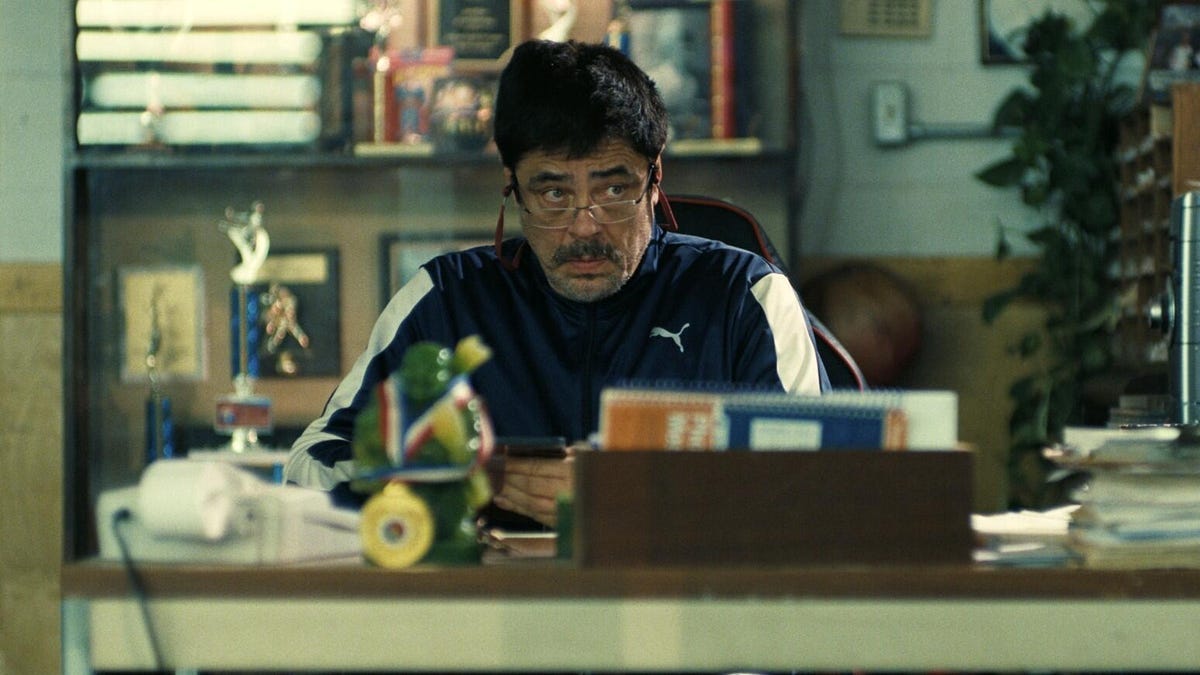
One Battle After Another is a movie about many things. It’s also a movie about Good and Bad Dads. Sergio aka Sensei (Benicio del Toro) isn’t just a Good Dad, he’s a Best Dad. A Dad for the ages. If you’ve seen the movie, you understand me immediately. If you haven’t, he’s not a “good dad” for his behavior towards his children (although he might also be that, it’s unclear). He’s the Good Dad for his entire community: for his martial arts students, for a group of rag-tag skateboarders, for undocumented immigrants who he helps shelter and protect. (No spoilers ahead, but I do describe some basic plot points of the movie).
We know Sensei is a Good Dad because of his actions (and his tracksuit) but also because of his humor, and the way other people respond to his requests. He is deeply beloved, and that belovedness has been earned.
Bob (Leonardo DiCaprio) is in the continual process of wresting Good Dadness from the clutches of Bad Dadness. His background has made him paranoid; his drug use has made him worthless. He is a loose, live wire — but one that vibrates with deep love and respect for his daughter. He is hapless, and he is a fool, but he is a Good Dad.
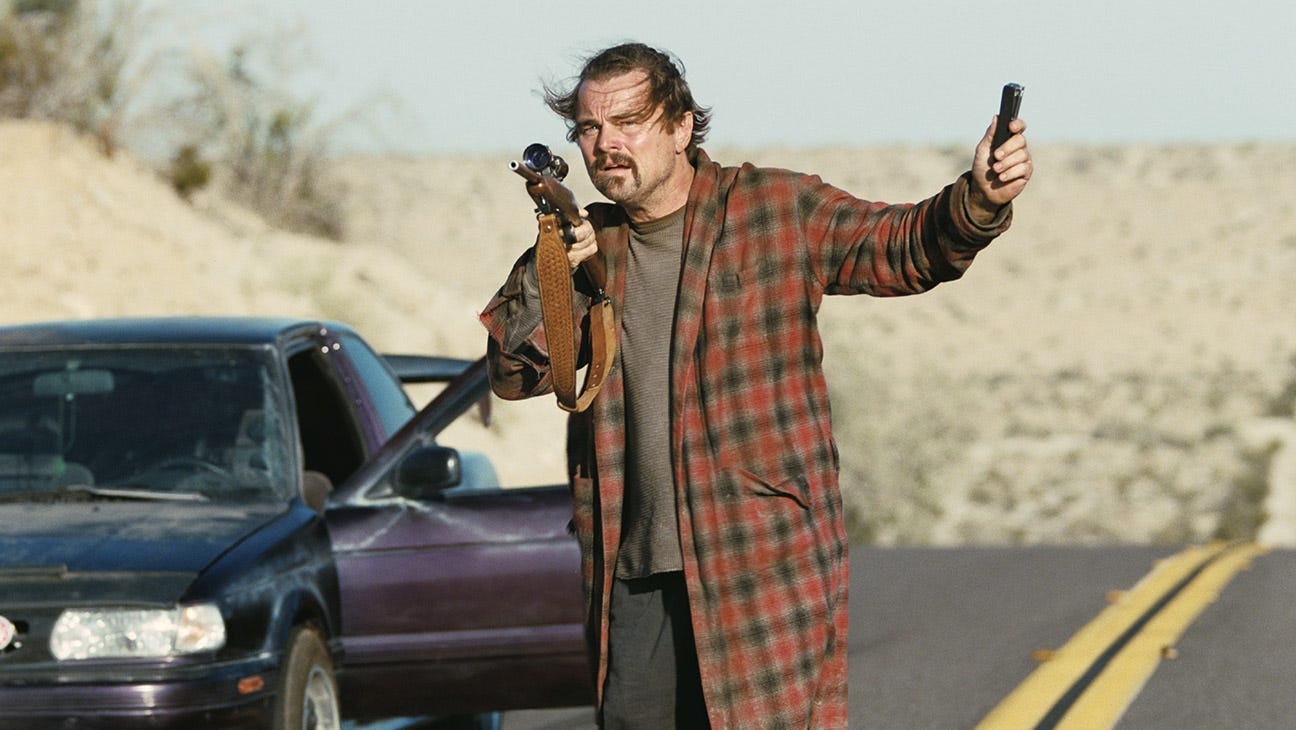
Neither of these Good Dads have money or societal power. But they are guided by moral compasses directed towards justice. Paul Thomas Anderson, who wrote and directed the film, makes the argument for the Good Dadness over and over: in the costuming, of course, but also in the direction of both performances, and the play of lightness and terror that underpin them.
We also know they’re Good Dads because they’re not the movie’s Bad Dads, each of which is played with great, deadpan self-seriousness. For those who haven’t seen the movie, a major plot point hinges on the involvement of “The Christmas Adventurers Club,” a group of men who invites the viewer to imagine what it would be like if everyone in Epstein’s Black Book and the people who’ve spent the most time at Mar-a-Lago formed a secret society rooted in white supremacism and global control. Like a very high-class, Yale-educated Klan, facilitated (but not controlled) by a man named Virgil Throckmorton (played, with delicious irony, by Tony Goldwyn).
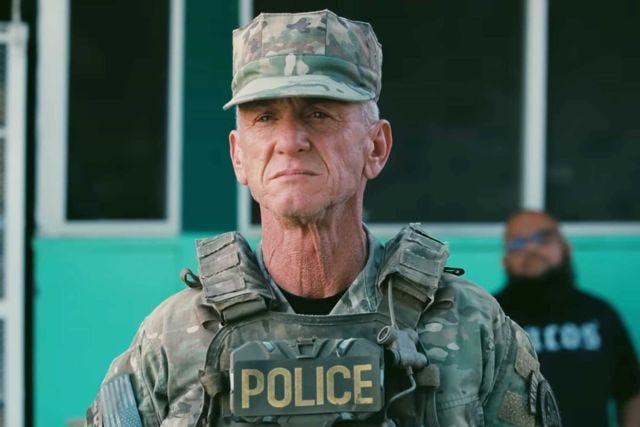
The Christmas Adventurers Club has offered potential membership to Colonel Stephen J. Lockjaw (Sean Penn), a domineering military commander best known for his “cleansing” work of immigrant populations. Early in the film, Lockjaw has a run-in with the revolutionary group that includes Bob and his girlfriend, Perfidia Beverly Hills (Teyana Taylor) and sparks (or fans) his fetish for Black, controlling women, which becomes a problem when Lockjaw’s history is combed over for potential Christmas Adventurer membership.
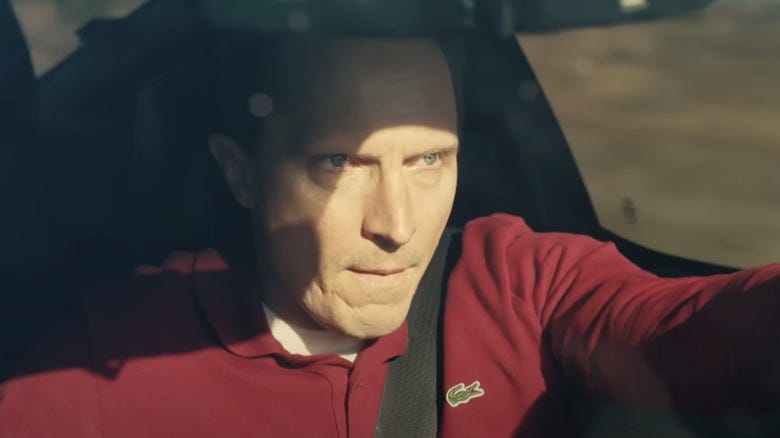
We know that Virgil (Tony Goldwyn) is a dad because he takes a break from his daughter’s wedding to interview a potential member for his white supremacist club. But we don’t know, for certain, if all of these other Christmas Adventurers are dads. We know they have a secret white supremacist bunker lair, which is very Bad Dad, and comb their hair like Bad Dads, and talk about their beliefs without any sense of irony or awareness, which is obviously peak Bad Dad. We know that they drive Bad Dad cars, and wear white shirts under LaCoste polos, the Baddest of Bad Dads.
Also: they are white rich men of a certain age: for them not to be would be a matter of curiosity and censure. Which is why Lockjaw, for all of his “cleansing” work, is suspect: he acts like a Bad Dad and drives the massive jacked-up truck of a Bad Dad, so where’s the wife and child that would make him a Dad? But biological fatherhood is not essential for Dadness, Good or Bad, and there’s a scene involving Lockjaw of such vivid Bad Dadness that I won’t spoil here but will not leave me.
The Bad Dads of One Battle After Another look like respectable, upstanding citizens who pay their taxes, or at least pay someone a lot of money so they pay very little taxes. We understand them immediately: they’re paragons of respectability, leaders in their community, deacons in their churches, and sponsors of Little League teams. They have immaculate dental health. Their lawns are mowed. And they are craven and heartless villains, obsessed with regenerating their own power. They are despicable, and they are ridiculous — and they absolutely live amongst us.
The Good Dads of One Battle After Another, by contrast, look like social problems. When Bob gets arrested while on the run during a protest, he’s carted into the gen pop holding tank, even though he’s wanted by the feds, because he looks like he’s unhoused. But those Good Dads, along with their daughters and friends and fellow travelers, are the beating, beautiful heart of this movie. And they, too, live amongst us.
In her essay collection Thick, sociologist Tressie McMillan Cottom explains what it means for a person of color to “know our whites”:
“To know our whites is to understand the psychology of white people and the elasticity of whiteness,” she writes. “It is to be intimate with some white persons but to critically withhold faith in white people categorically. It is to anticipate white people’s emotions and fears and grievances, because their issues are singularly our problem. To know our whites is to survive without letting bitterness rot your soul.”
Know your whites. Know your dads. ●
The comments are a subscriber-only space; that’s part of what makes them one of the good places on the internet. We’ve learned how to talk to each other about stuff that matters — like Good and Bad Dads. If you’d like to join the discussion — and get this week’s Things I Read and Loved, including the Just Trust Me — subscribe below.