

Meet Wound Man
Wound Laws, A Revised History of the Printing Press, Archive Nerdery, and the Marvel Universe of Medieval European Science
Before this week’s interview, I wanted to draw your attention to the Consistent Money Moving Project. I first heard about it from the great Lydia Kiesling back in 2021 and have been part of it since. It’s very straightforward: every week, people with a little extra give to others who could use a little extra. No bureaucracy, no hoops to jump through, just money moving to people who really need it. You can read all about the details here, but the TL;DR is that every week I get a Venmo request for $10, and then that $10 joins a lot of other people’s donations. This past cycle, around 400 people donated weekly (anywhere from $3 to $100) and 25 people in the DC area received between $205-225 a week. It’s small, it’s basic, and it matters.
If you’d like to sign up to join this cycle, it’s very straightforward — just fill out this Google Form. Sign-ups for this coming round ends on August 22nd, so do it now!
Also: this week’s Tuesday Thread was a practical one (Very Good Bags) but Friday’s Thread is gonna be emotionally hefty: What Are You Struggling With That No One Else Sees? If you’re already a subscriber, get ready. And if you want to be part of the conversation — which reliably reaches somewhere between 500 and 1000+ comments — become one today:

Now, as for this week’s interview. I’ve been talking about Wound Man all week, and this interview does not disappoint: you might not think you’re interested in medieval medical drawings, but give this interview a few minutes of your time and I promise you will be (or at least know a lot more about them that you can then drop in casual conversation).
Jack Hartnell is particularly skilled at articulating what makes these artifacts not just interesting but illuminating. (You might have heard of his previous book, Medieval Bodies: Life and Death in the Middle Ages, which invited readers to think differently about the “backward” practices, particularly around the body and its treatment, that typify the popular understanding of that era). Wound Man is a brilliantly researched, engagingly written, and beautifully illustrated book, and as I wrote this Sunday, the fact that I can run something like this in Culture Study (and know that you, as readers, will approach it with curiosity instead of disdain) is one of my favorite parts of writing this newsletter.
So let’s get curious and nerdy — and learn a bit more about the Marvel Universe of Medieval European Science.
You can find out more about Jack Hartnell’s work here and buy Wound Man: The Many Lives of a Surgical Image here.
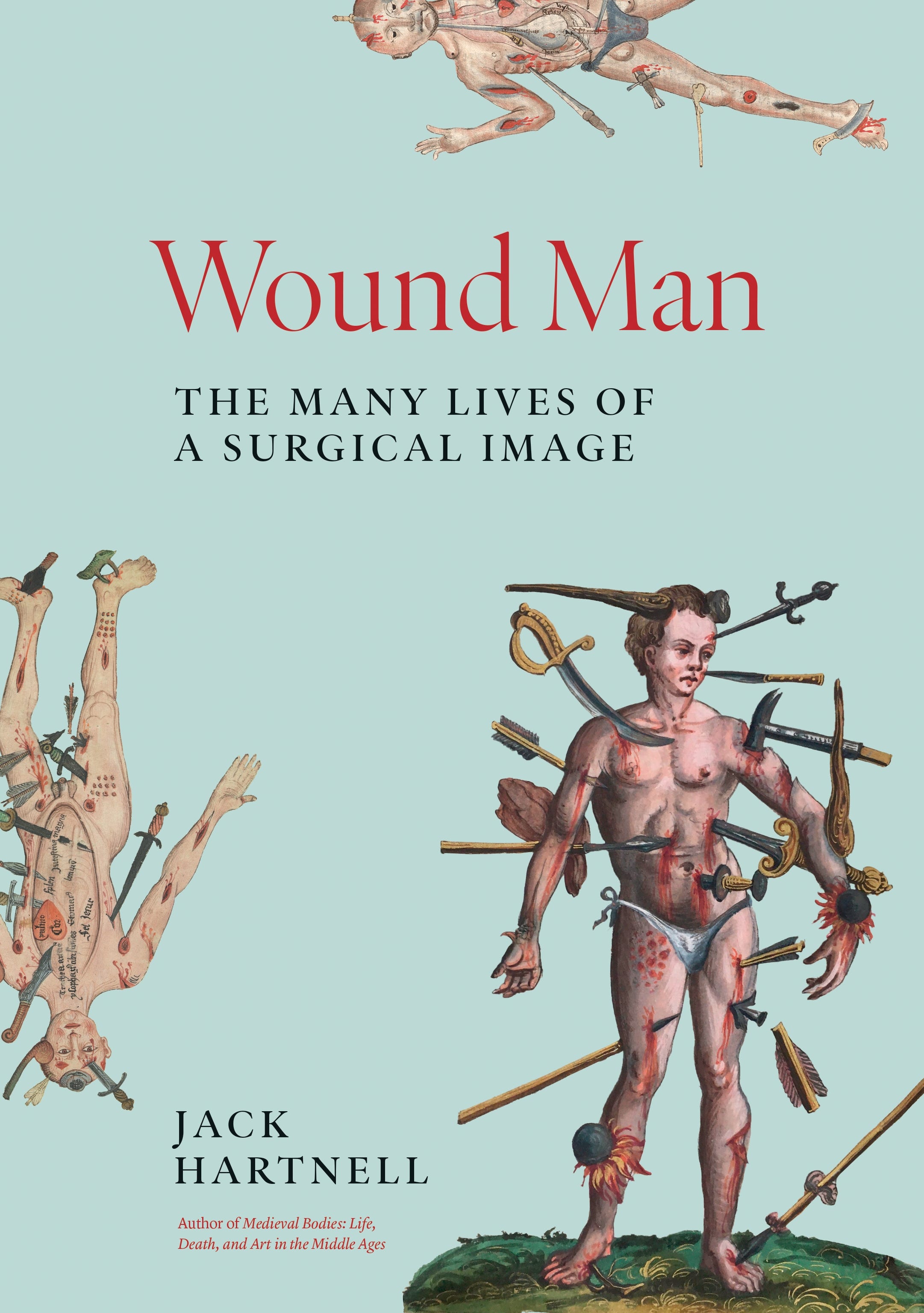
When I first read about your book, the title struck me as the sort of lightly macabre character one of the kids in my life might conjure: a man composed entirely of wounds. Which he is! But he is also, as you point out in the beginning of your book, quite stoic about it — which is foundational to your argument that the Wound Man is “an imaginative and arresting reminder of the powerful knowledge that could be channeled and dispensed through the practice of premodern medicine.”
To get us started, can you elaborate on that idea — and what, ultimately, is so illuminating about the proliferation of Wound Men [a phrase you don’t use but strikes me as quite funny] across the globe over a three-hundred year timespan in the Middle Ages?
The phrase “Wound Man” definitely sounds like a superhero, I agree! He’s actually turned up in this guise across a variety of more modern plays, albums, poems — a real inspiration for many creative thinkers over the years, including none other than the author Ian Fleming, who wanted to call the sixth book in his James Bond series of spy thrillers “The Wound Man”, but was instead forced by his publisher to go with “Dr No”!
The term is in fact a translation of the German word ‘Wundenmann’, which was first used to describe the medieval medical figure back in the 1910s by a historian named Karl Sudhoff. Sudhoff was working right at the beginning of the twentieth century and was one of the first people to write in a sustained way about all sorts of really interesting medieval images from the perspective of medical and scientific history. His term actually puts the Wound Man into dialogue with several other of these figures: Zodiac Man, Planetary Man, Bloodletting Man, and so on — so plenty of other medical diagrams that we could use fill out the full Marvel Universe of medieval European science.
The long history of this term, however, conceals the fact that although the Wound Man has been known to this particular niche of medical historical scholarship for more than a century, at least by name, it has taken until now for someone to actually sit down and write at length about this image’s remarkable history. I found it so strange when I first started conceiving of this book that the figure had generated so little sustained scholarly curiosity.
I think this maybe has something to do with your second point: the relationship between the Wound Man’s strikingly macabre surface and its really complex original purpose, a background which is actually quite stoic, calm, and technical. Anyone who has mentioned the Wound Man to date has tended to focus on its former aspect, speaking about him as an exclusively sensational and grotesque image. But the more I looked into the figure and its long history, the more I discovered that there were many, many different uses to which this image was in fact being put, many reasons for different kinds of people in the past — surgeons and physicians but also scribes, artists, students, religious communities — to want to present him on the page in their endeavours.
Moreover, it was very quickly apparent that this image was of interest to people for many, many centuries: the earliest example that I found comes from the late 1300s and it remained an extremely popular image (in part because of this variety of users) way through into the 1800s and beyond. So, in short, this book is really an attempt to gather together some of these different “lives” that the Wound Man inhabited and understand them better. When we do, all sorts of interesting through-lines seem to emerge, most of all the idea that something which on the surface seems to be extremely graphic and unpleasant might in fact be informative, empathetic, creative, even artistic.
As a follow-up question that I’m hoping will ground us a bit more in your research process: please get very detailed about how you tracked down 93 Wound Men, many of which were not held in collections (we are process and archive nerds, have no fear). Is it weird to ask you to pick a favorite rendering (and explain why)?
You’re right, this was probably one of the most intensive aspects of researching the book, although this is a project that I’ve been thinking about for some time, almost a decade on and off, and so there has been plenty of time for fortuitous discoveries to pop up along the way. I also think that undertaking a long research project like this is a little bit like when you first hear a new term or new word or a person’s unusual surname in conversation and then you notice it cropping up all over the place. Your brain gets almost subconsciously attuned to the kinds of spaces this image is likely to appear, and so you’re on the lookout without really realising.
That doesn’t mean you just sit back and things come to you, though - there is a lot of legwork involved! In this project, I’ve been hugely helped by the incredible work of librarians, archivists, and digital humanitarians of many different types all around the world who have led the charge in shepherding enormous waves of cultural heritage objects (in my case manuscripts and printed books) online into complex databases and digital libraries.
I’m an art historian by training, so I really firmly believe that direct encounters with works of art are incredibly important to understanding all sorts of aspects of their facture, their impact, their effect on the viewer, and so on. But being able to browse through literally thousands of books online for this project, and to do so at real speed, has been invaluable and means I was able to cover in a few years probably more materials than someone like Karl Sudhoff, working in the early twentieth century, could cover in a lifetime.
A lot of this work is pretty instinctive. The digitised collections I work from are extremely varied, ranging from tiny gatherings of manuscripts in surviving medieval religious institutions through to enormous collections of printed books held by national repositories. It takes a while to become familiarised with a particular institution’s form of cataloguing, the structure of the metadata that they provide about their objects, and so on. But slowly, after spending a fair bit of time with each particular collection, you begin to get your eye in and understand which items are likely to reward close and careful looking and which could maybe be quickly skimmed.
The result of these large scale digital trawls essentially means that I can then draw up a significant long-list of items which, at least to judge from their digital counterparts, require me to delve much more deeply into them with an in-person visit. That’s when a second round of discoveries tended to take place, really getting into the detail of reading these manuscripts first-hand, discovering a name here, a place there, a fact or a detail that I could follow up on using more traditional historical methods.
A caveat to this approach: for all that the digital world provides an amazing capacity for overview and for understanding materials at a distance, we have to always remember that it’s hugely imbalanced in terms of coverage, something that follows from huge imbalances in opportunity and national infrastructure. The Wound Man began its life in medieval Germany and Bohemia, which was extremely fortunate for me because German libraries and archives have led the way and set the standard in excellent (in some case almost exhaustive) digitisation.
But just over the border in Italy, different funding priorities and the complexities of working with much less federalised networks for cultural heritage mean the digital coverage is comparatively poor, in some cases non-existent. So it’s really beholden on me as a scholar wanting to do justice to the full breadth of my materials to understand this landscape and act accordingly to balance what is available online.
A handful of Wound Men in the book were also not my own finds: because this project became such a long-term undertaking, stretching over many years, I was able to build up some really rich networks of scholars interested in similar ideas to my own and who were often generous enough to point me in the direction of their own discoveries, and they are cited in the book as such. Just before the book was about to go to press, for instance, a friend told me that they had seen an image of the Wound Man in a manuscript that was actually up for sale on display in a commercial bookseller’s shop. I was then able to communicate with the dealer and visit the manuscript myself, and we ended up having an interesting conversation about the book’s unusual provenance. I think sometimes scholars of historic artefacts shy away from ‘The Market’ as somehow grubby and un-objective, but the people who operate in this world really have seen it all and have themselves often accrued exceptional knowledge-banks of materials through practical experience, all of which can be invaluable for someone on the more academic side of things.
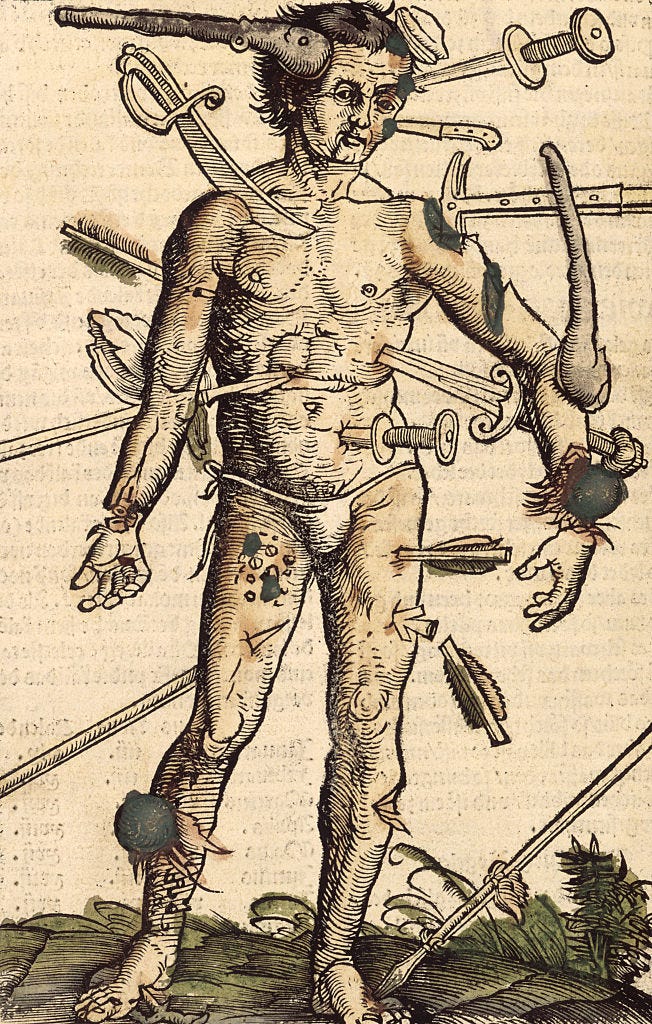
As for a favourite Wound Man: there are so many very beautiful images to choose from, but perhaps because of this fact my current favourite surely has to be one from a manuscript now in the Zentralbibliothek in Solothurn, Switzerland, which has to be one of the very worst images I have ever seen in my life. It really looks like a child produced it. But, perversely, as a result this is an image which tells us so much: that the Wound Man wasn’t just about fancy pictures and high-end artisans - rather, it was also a working image, something that a practicing medic could jot down in their own notebook for reference in learning more about their craft!
I was enthralled by the section of the book on “wound laws” — and just the general way that physical and emotional harm was conceived and communicated (and compensated for). Can you outline how they (and wergelt, aka “man-money”) worked, and how they drew from the wound man imagery that was in circulation at the time?
Wound laws are extremely interesting, and in discussing them in the book I’m drawing on a fair bit of scholarship undertaken by some great legal historians, especially those working in northern European contexts where such laws are probably best preserved. Essentially it’s the biblical notion of “an eye for an eye” translated in more fiduciary terms: “an eye for a dollar”, or what contemporary writers called wergelt, as you say, literally “man-money”.
This cost was to take into account both the specifics of the damage done and, more complicatedly, the original capacities and merits of the victim before injury. The result was most often a series of published tariffs that acknowledged that different parts of the body required compensation at different levels. For instance, tariffs from Old Frisia (now the northern Netherlands and northwestern Germany) individuate over 150 bodily locations for injury, taking in everything along the way from eyelid and moustache to uterus and kneecap. The specific execution of the injury and its relation to the victim’s prior standards of living were also considered important, something that towards the end of the Middle Ages was evaluated by official wound assessors, mostly surgeons, dispatched by local authorities and charged with taking context into account to help determine final compensation. They considered, among other things, whether the injury was committed in the victim’s home, how easy an injury would be to conceal from others, whether a professional would be required to cure the wound, and the degree to which the wound would have lasting effect on the function of the victim’s senses, a crucial marker for the potential standards of future living.
The level of detail found in these laws is striking, suggesting the sheer array of injuries that medieval authorities were familiar with litigating against — and many marry closely with those depicted on the Wound Man’s ghastly form. Given how widespread this culture of bodily compensation was in German-speaking lands, we can imagine viewers coming across the figure in a manuscript with a sense of legal fright, both for the significant financial compensation he represented and the potential bill of bodily retribution due to whomever had enacted his multiple injuries.
I also loved the section of the book where you use the spread of Wound Man as a case study for the way the printing press was actually functioning (where, how, and why) in the 15th century. (As opposed to: the printing press was invented, then it sprouted up like mushrooms all over civilization, then the world changed, the end).
I’d love to hear you riff a little on how the Gregoris Brothers’ printings of Wound Man show us the instability of printing technique at the time and the way printers like them were innovating to exploit the “middle market” for medical images/pamphlets/prints.
This part of the book came about first and foremost because of a frustration at how the current history of medicine and of art described the first printed medical images to be found in Europe in the late 1400s. The Wound Man itself was first printed in Venice in 1491, part of a medical compendium called the Fasciculus medicinae or ‘the little bundle of medicine’ printed by a pair of brothers working in the city, Giovanni and Gregorio de Gregori. This text is often described, unthinkingly, as the ‘first printed medical book’ — but all it takes is a cursory look at texts being printed in Venice, indeed all over Europe from the 1450s onwards, to see that medical images appear all over the place. So I dedicated a chapter in a book to tracking the origins of these works down in a more comprehensive way, including examining the very first pharmacological books on medical botany, and all sorts of other texts depicting bloodletting or anatomical dissection in action.
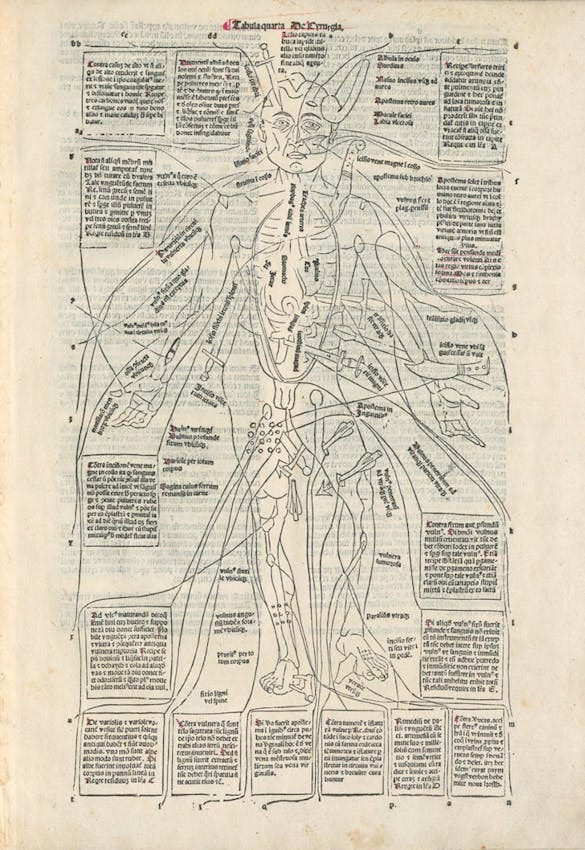
The Gregori brothers seem to have decided upon printing the Facisculus in part to appeal to the nearby medical communities at work at the University of Padua, a real centre for the study of medicine in the period. Their book is basically a medieval medical compendium of the kind we find quite commonly in manuscript form, reproduced using the cutting-edge new technologies of moveable type and woodblock images. In fact, in the case of the Wound Man small pieces of moveable type have actually been inserted into the woodblock image to allow the figure’s curving lines and textual labels to sit comfortably together. This 1491 edition, printed on unusually large-format paper, would have surely appealed to the highfaluting university scholars, packed full of Latin medical texts as well as images like the Wound Man.
But if we follow the publishing history of this text, the story isn’t quite that simple… Only a few years later, in 1494, the Gregori brothers themselves published another version of the book printed this time not in Latin but in Italian, suggesting that there was a growing market among non-Latin speaking audiences, presumably from an up-and-coming middle class of merchants or bibliophiles (i.e. not trained medics) for a short text on medical matters.
In the same year, a Catalan version of the text was printed in Spain, followed soon after by versions in German, English, Dutch, and many more Italian versions, all produced in emerging print centres across the continent. So something that seems to have started out as quite a specialist book was very quickly adapted amid this moment of speedy technical evolution for a mainstream audience. This is what I mean by a “middle market”: people interested in a book whose practical medicine was theoretically sound, good enough for university doctors, and yet which still foregrounded a suite of popular, vibrant images as a way of organising and advertising its abbreviated medical contents using the very latest reproductive technologies.
I’m hoping we can situate your work more broadly within art history — some people reading this newsletter might still think that “art history” remains generally limited to, I dunno, a survey of Modernist Painting taught in Mona Lisa Smile. But the field is so much more expansive, weird, and global, and you make such a convincing case for the Wound Man, however “sandwiched between disciplines,” as a piece of illustration (and media!) that tells us so much about the people who consumed, referenced, and reproduced it. This is a reach, but what are artifacts “between disciplines” from today’s world that might fit a similar role? What might they tell scholars of the future?
I said earlier that the Wound Man’s history has been overlooked: that scholars have known about it for more than a decade, but it’s taken until 2025 for someone to actually write a book about this figure’s long history. And I really do think this is largely down to the ‘in-between-ness’ you draw our attention to here. Diagrams, of which you could say the Wound Man is an interesting example, have a simplistic aesthetic which often sees them deemed too insubstantial for ‘serious’ study by art historians, who generally prefer to spend time with much more ‘beautiful’ stuff.
Meanwhile, the words and labels which accompany such diagrams never quite seem sizeable enough to reach the independent status of a ‘text’, the bar often necessary for literary scholars to sit up and take notice, preferring instead to spend time with more substantial sonnets and novels. This is a bit of a caricature of both sides of the word-image divide, but I think it still pertains to some practitioners and definitely to public opinion of art and of science, where the appreciation of images, objects, and ideas which fall between two different areas of understanding can often be quickly labelled as too complex, too obscure, even plain weird.
Today, the overarching discipline of the medical humanities tries to keep up a parity between two of these conceptual extremes, between the methods of history and the materials of health. Yet as with many aspects of the historical field, the rich medical humanities of modernity and the present day are all too often allowed to overpower the important contributions of medical visual culture from a more distant era: explorations of the x-ray, robotics, genomics, artificial intelligence, and so on often trump a dusty old manuscript.
My goal in writing this book was to make sure that premodern voices are kept loud and strong in these discussions, and that material which falls in between periods as well as in between disciplines is raised up by this conceptual overlap rather than become sidelined. In this sense I feel like the Wound Man reveals a really interesting process of medico-artistic entanglement, one which can transport the reader as an intricate and unique site of contact between often opposing things: sickness and cure, beauty and ugliness, painting and print, suffering and sanctity, art and science.
As for future historians and things today that sit between disciplines: I think we’re way too close to our own moment to tell! Breaking ideas down into disciplines is surely too hard when we’re up close to all the overlaps - we’re living in the middle of the Venn diagram, and it’s only when our world is so fragmentary and distant that it requires whole disciplines to re-piece it that I think these areas of elision between fields can probably take place.
In terms of the Wound Man, when scholars speak of historical objects as activating debate, inculcating power, or voyaging the oceans, or whatever else historians of the moment are interested in, their minds are far more likely to jump to the ricocheting histories of painting and sculpture, of diplomatic gifts, even of bulk goods than they are to medical diagrams. Yet the Wound Man’s history makes clear that healing images from before the modern era undertook all of these roles and more. ●
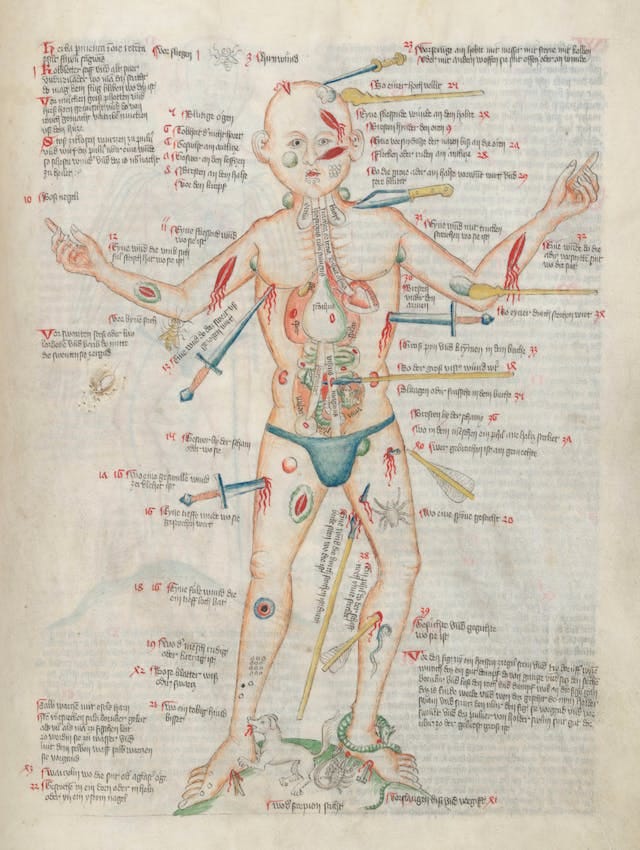
You can read detailed analysis of several images of Wound Man (including two of those pictured above) in this short piece by Jack Hartnell for The Public Domain Review.
You can find out more about Jack Hartnell’s work here and buy Wound Man: The Many Lives of a Surgical Image here.
When I saw this come into my inbox, I thought 'uh oh, proceed with caution'.
I spent more than 13 years in a History of Medicine collection that Jack knows very well - Wellcome Collection. I was a Product Manager working on their digitised collections, search, etc. When I saw the image for Wellcome's wound man (last image in the post), I of course had to click through to see it on 'my' product, again. And the link is broken! It's not you, Anne-Helen, it's that bloody API acting up again! Reference numbers have clearly gone awry.
For those who want to dig into more of Wellcome's various Wound Men, here are two for your delectation:
WMS.290 - https://wellcomecollection.org/works/tp6fppqz/images?id=s35fgzpt
MS.49 (AKA Wellcome Apocalypse) - https://wellcomecollection.org/works/du9ua6nd/items?canvas=73
And if you really want to see centuries-old manuscripts depicting people being poked with things, Wellcome Collection is your place.
~ Wound Man, come together with your glands ~